EXHIBIT 99.2
Published on October 20, 2026
Exhibit 99.2
| 1 DeepFission.com October 2026 Nasdaq: FISN Business Update |
| This presentation includes forward-looking statements within the meaning of federal securities laws, including the Private Securities Litigation Reform Act of 1995. Forward-looking statements describe future expectations, plans, results or strategies and can often be identified by the use of terminology such as "anticipate," "believe," "could," "estimate," "expect," "intend," "may," "plan," "potential," "project," "seek," "should," "target," "will," "would," and similar expressions, although not all forward-looking statements contain these identifying words. These statements include statements regarding Deep Fission's technology development, regulatory activities, commercialization plans, anticipated reactor deployments, strategic partnerships, market opportunities, future operating performance, financing plans and growth strategy. Forward-looking statements are based on current expectations and assumptions and involve risks and uncertainties that could cause actual results to differ materially from those expressed or implied. Important factors include Deep Fission's ability to obtain financing, secure regulatory approvals, develop and deploy its technology, achieve anticipated technical and economic performance, secure customers and commercial agreements, obtain fuel and critical supplies, manage costs and timelines, and other risks described in Deep Fission's filings with the Securities and Exchange Commission. Deep Fission's forward-looking statements are based on information available as of the date of publication. Except as required by law, Deep Fission does not undertake any obligation to update these statements. This presentation is not an offer to buy or sell, or the solicitation of an offer to buy or sell, any securities of Deep Fission, Inc. or any other person. 2 Forward-looking statements |
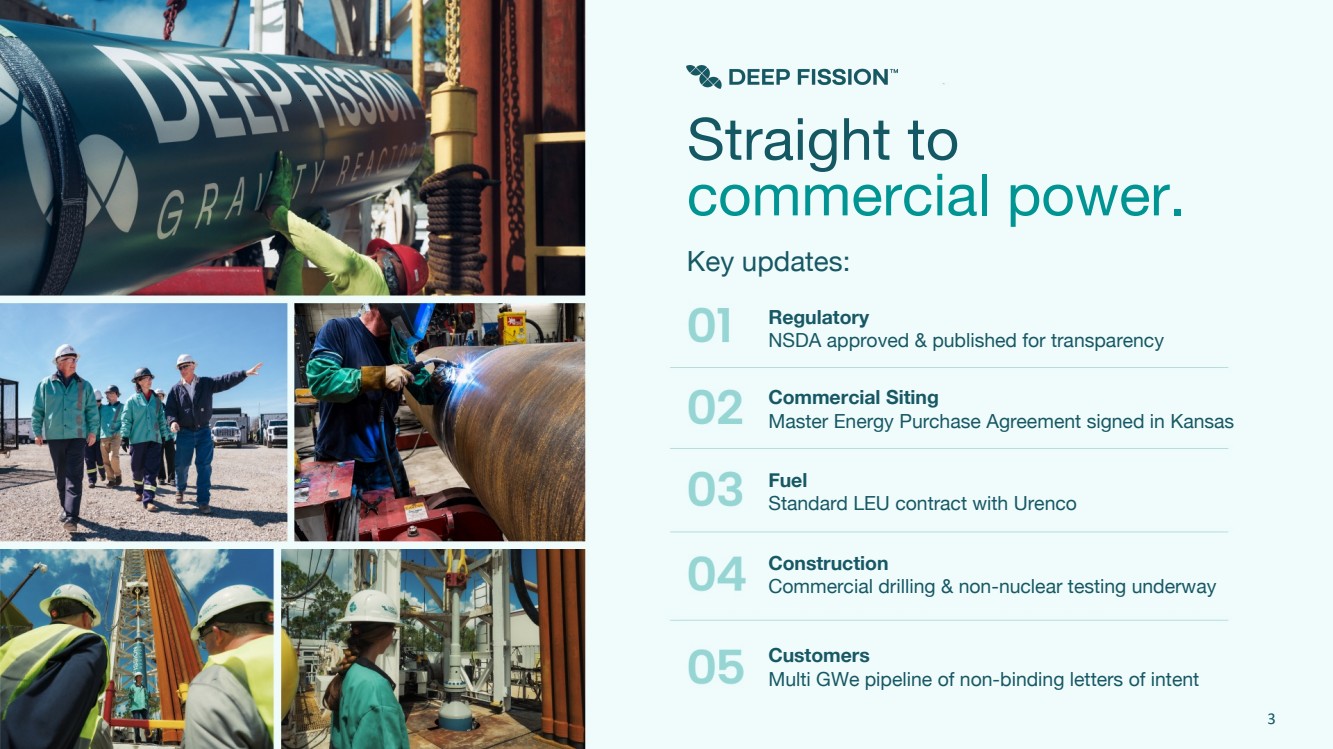
| Straight to commercial power. Key updates: Regulatory NSDA approved & published for transparency Commercial Siting Master Energy Purchase Agreement signed in Kansas Fuel Standard LEU contract with Urenco Construction Commercial drilling & non-nuclear testing underway Customers Multi GWe pipeline of non-binding letters of intent 3 |
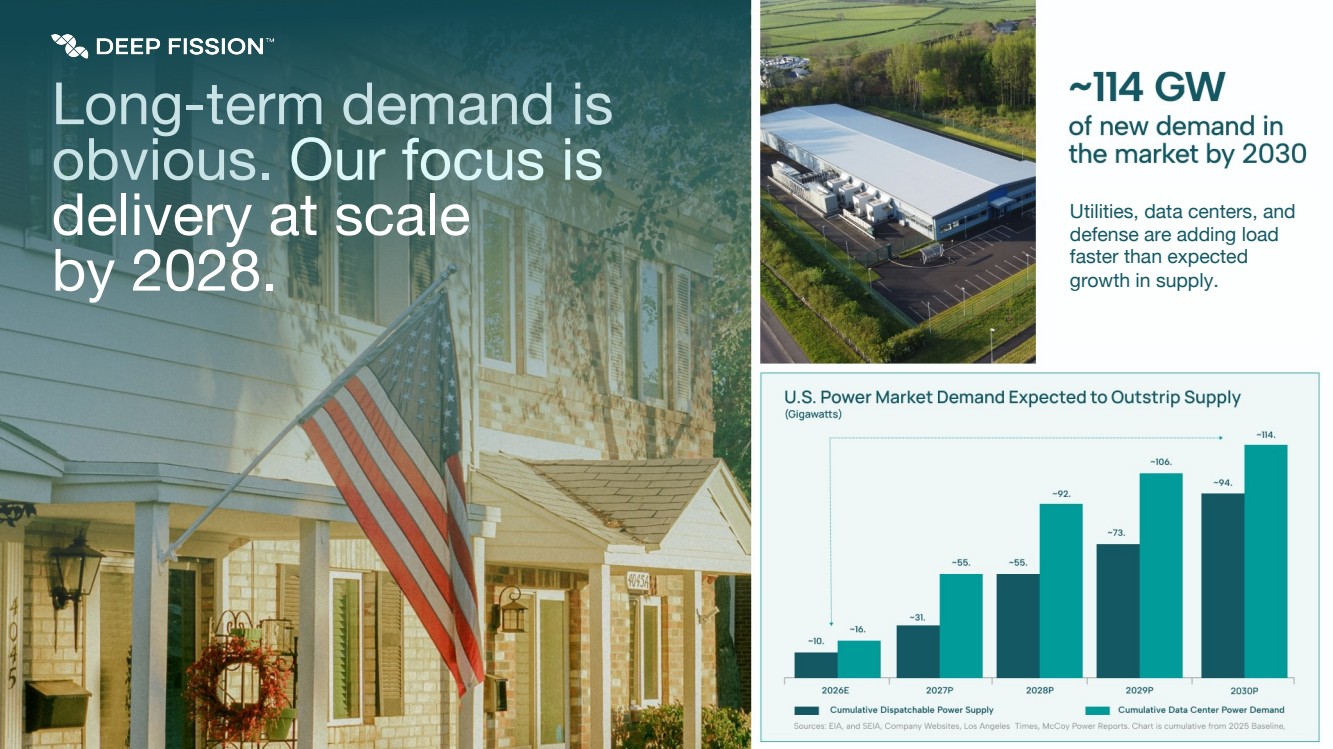
| Long -term demand is obvious. Our focus is delivery at scale by 2028. Utilities, data centers, and defense are adding load faster than expected growth in supply. |
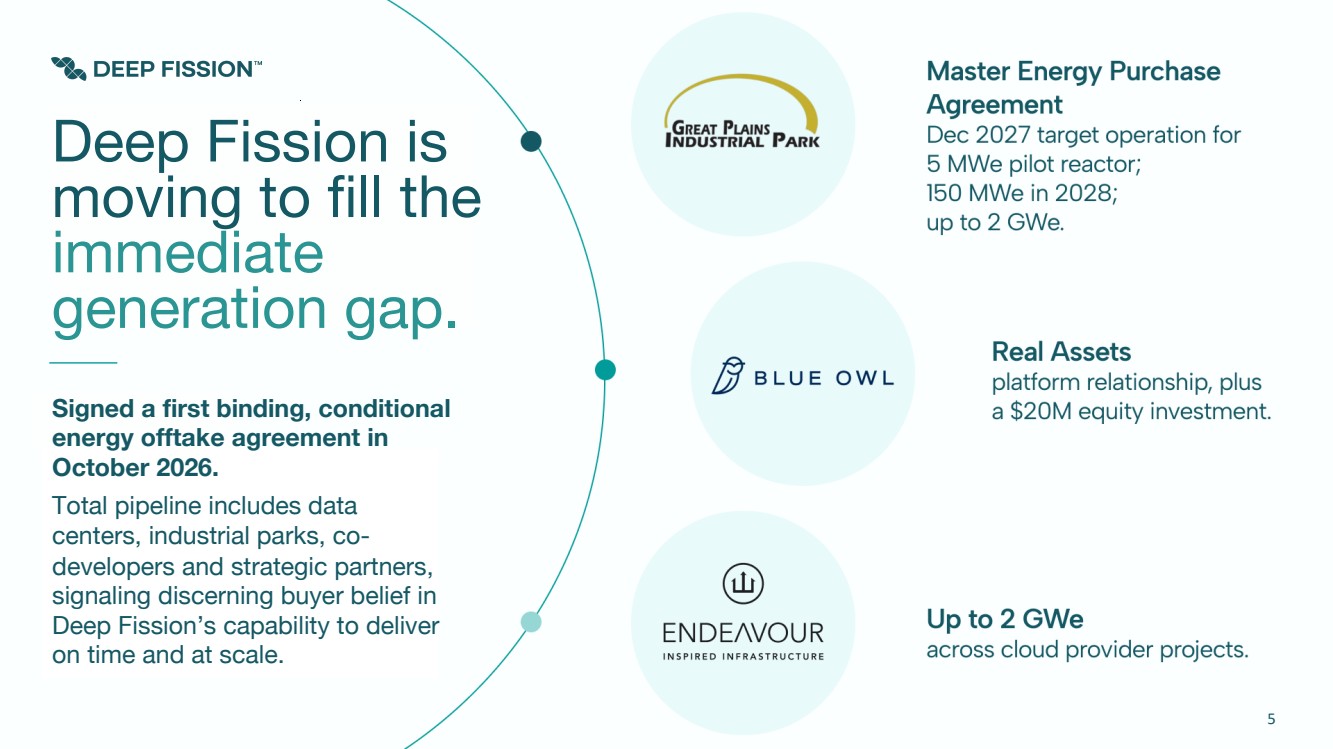
| Deep Fission is moving to fill the immediate generation gap . 5 Signed a first binding, conditional energy offtake agreement in October 2026. Total pipeline includes data centers, industrial parks, co - developers and strategic partners, signaling discerning buyer belief in Deep Fission’s capability to deliver on time and at scale. |
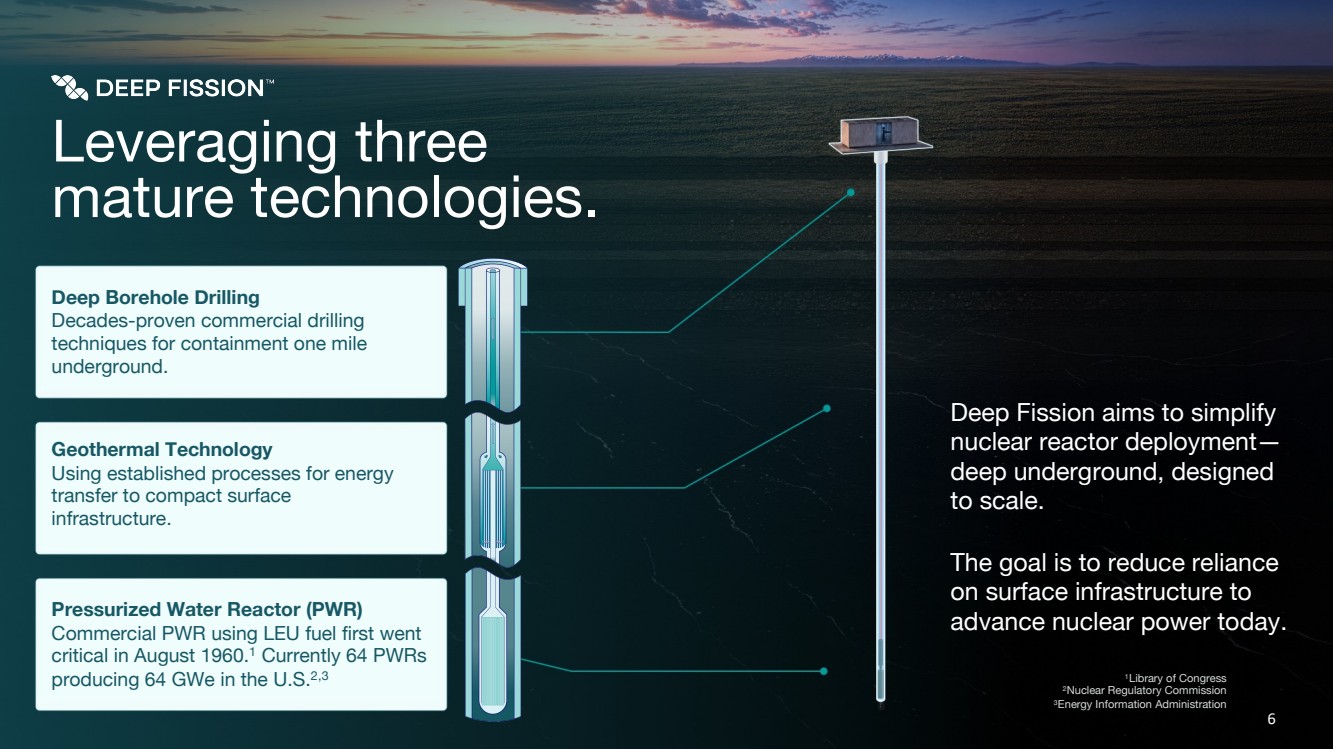
| Leveraging three mature technologies. Deep Borehole Drilling Decades -proven commercial drilling techniques for containment one mile underground. Geothermal Technology Using established processes for energy transfer to compact surface infrastructure. Pressurized Water Reactor (PWR) Commercial PWR using LEU fuel first went critical in August 1960. 1 Currently 64 PWRs producing 64 GWe in the U.S.2,3 1Library of Congress 2Nuclear Regulatory Commission 3Energy Information Administration Deep Fission aims to simplify nuclear reactor deployment — deep underground, designed to scale. The goal is to reduce reliance on surface infrastructure to advance nuclear power today. 6 |
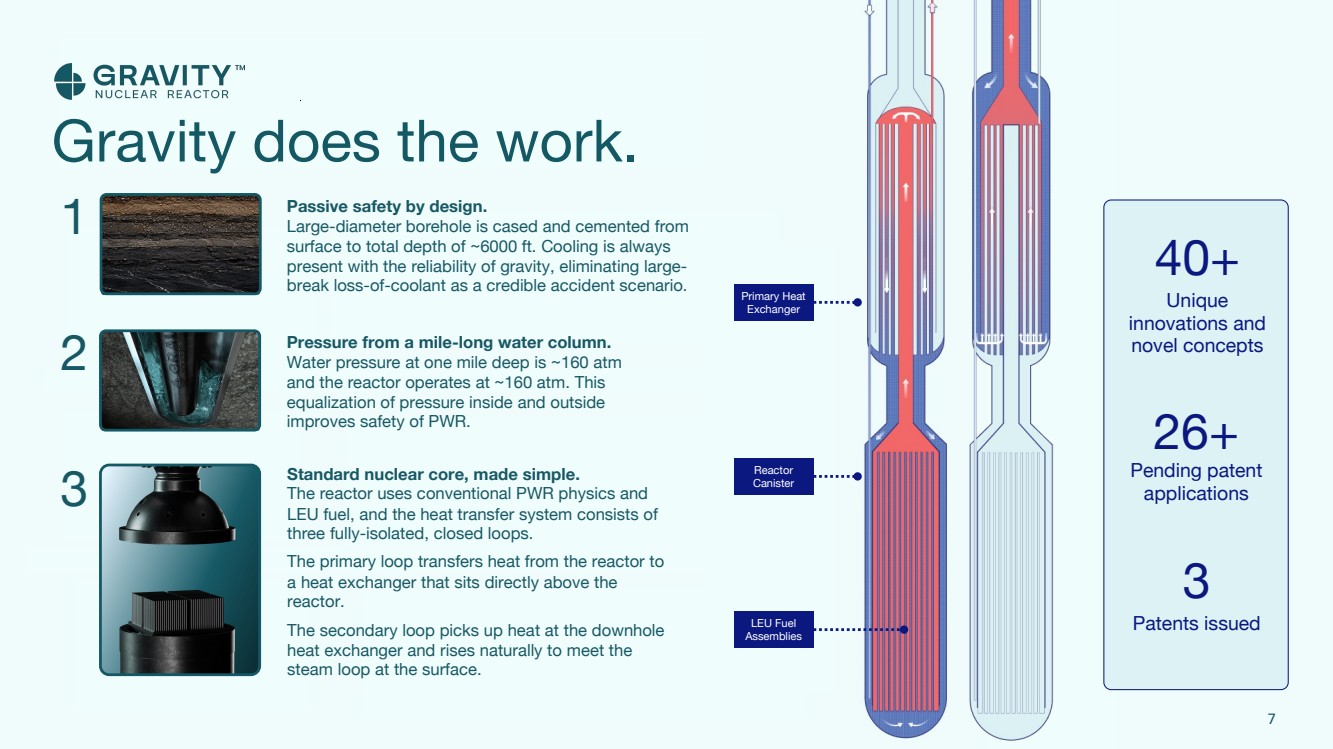
| d Primary Heat Exchanger Reactor Canister LEU Fuel Assemblies Unique innovations and novel concepts Gravity does the work. 40+ Pending patent applications 26+ Patents issued 3 Passive safety by design. Large -diameter borehole is cased and cemented from surface to total depth of ~6000 ft. Cooling is always present with the reliability of gravity, eliminating large - break loss -of -coolant as a credible accident scenario. Pressure from a mile -long water column. Water pressure at one mile deep is ~160 atm and the reactor operates at ~160 atm. This equalization of pressure inside and outside improves safety of PWR. Standard nuclear core, made simple. The reactor uses conventional PWR physics and LEU fuel, and the heat transfer system consists of three fully -isolated, closed loops. The primary loop transfers heat from the reactor to a heat exchanger that sits directly above the reactor. The secondary loop picks up heat at the downhole heat exchanger and rises naturally to meet the steam loop at the surface. 123 7 |
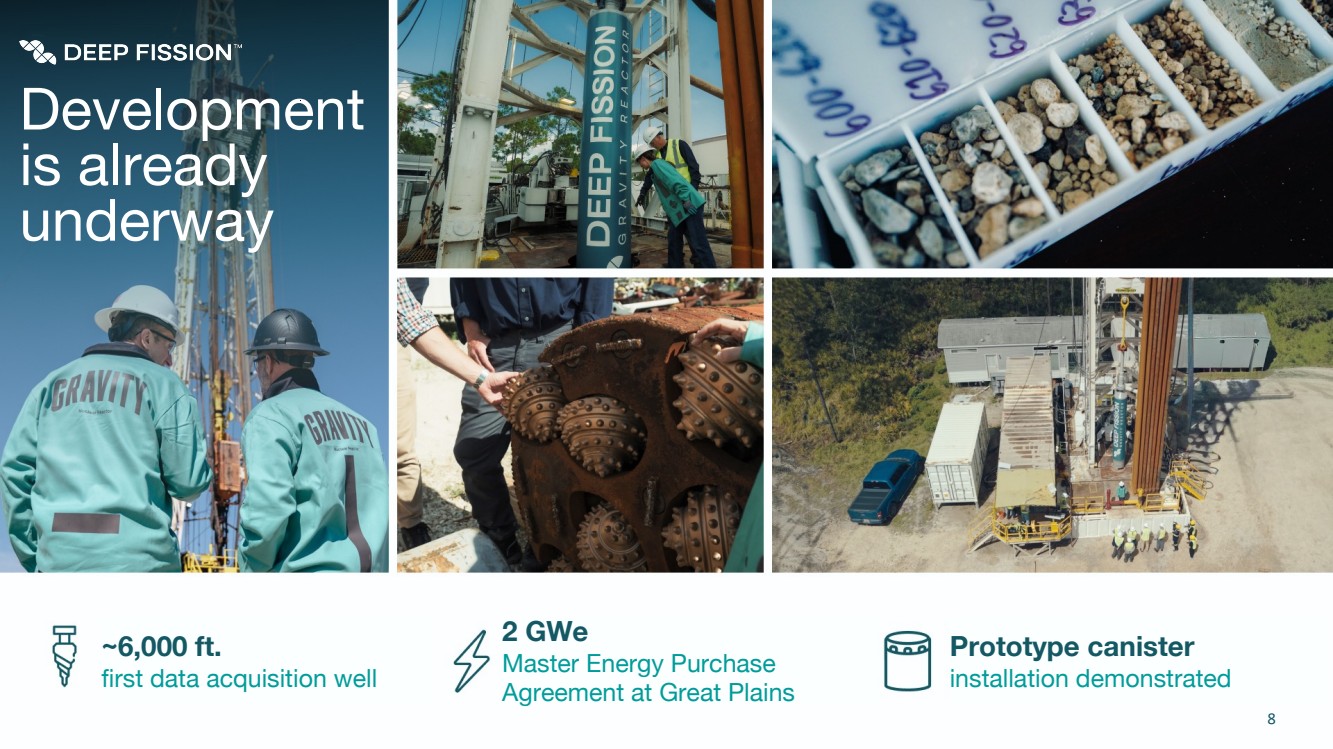
| Development is already underway 8 Prototype canister installation demonstrated 2 GWe Master Energy Purchase Agreement at Great Plains ~6,000 ft. first data acquisition well |
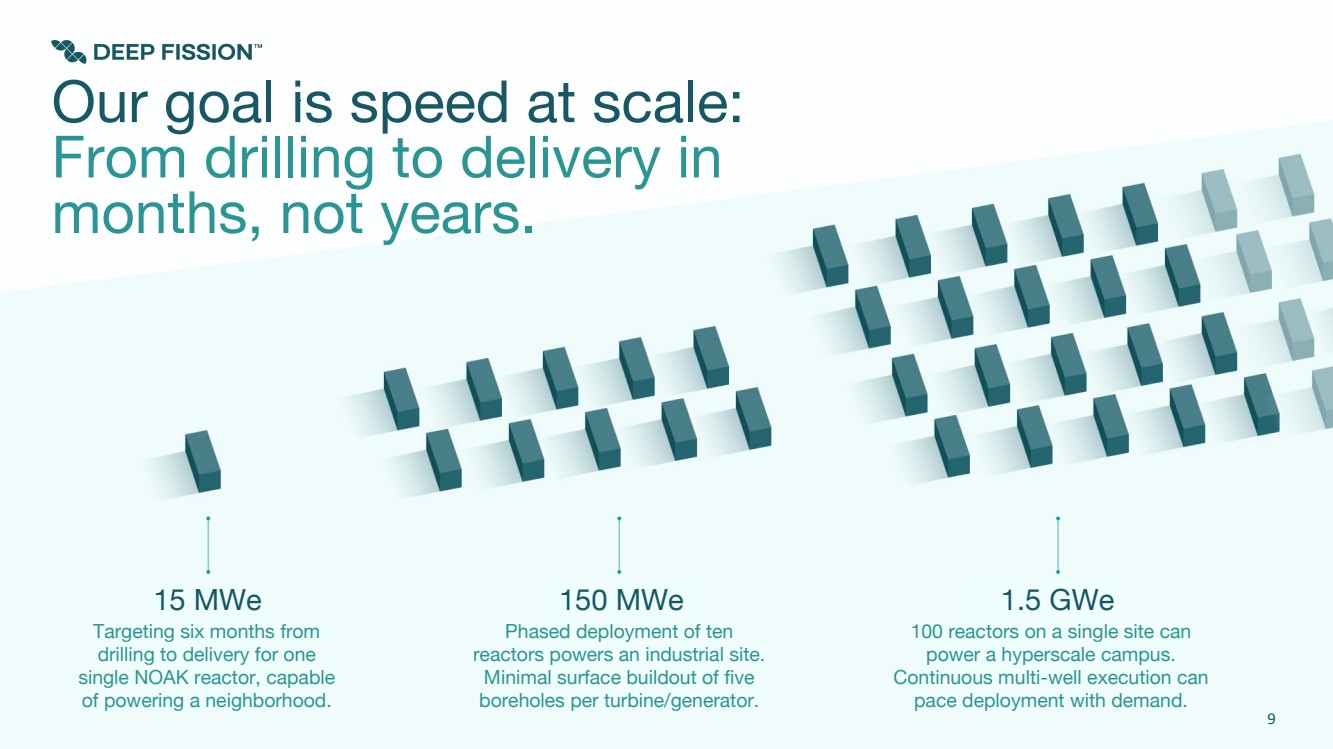
| Targeting six months from drilling to delivery for one single NOAK reactor, capable of powering a neighborhood. Phased deployment of ten reactors powers an industrial site. Minimal surface buildout of five boreholes per turbine/generator. 100 reactors on a single site can power a hyperscale campus. Continuous multi-well execution can pace deployment with demand. Our goal is speed at scale: From drilling to delivery in months, not years. 15 MWe 2 GWe 9 150 MWe 1.5 GWe |
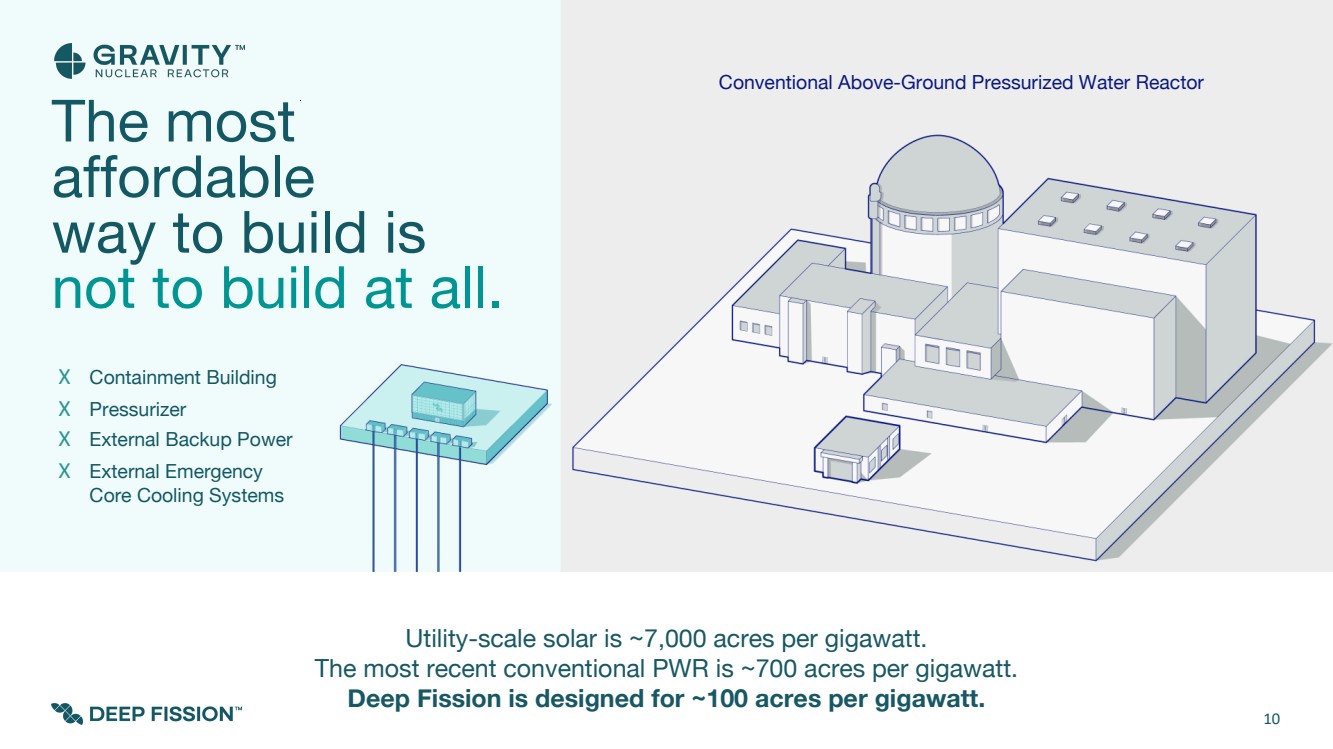
| The most affordable way to build is not to build at all. Utility-scale solar is ~7,000 acres per gigawatt. The most recent conventional PWR is ~700 acres per gigawatt. Deep Fission is designed for ~100 acres per gigawatt. Conventional Above-Ground Pressurized Water Reactor 10 X Containment Building X Pressurizer X External Backup Power X External Emergency Core Cooling Systems |
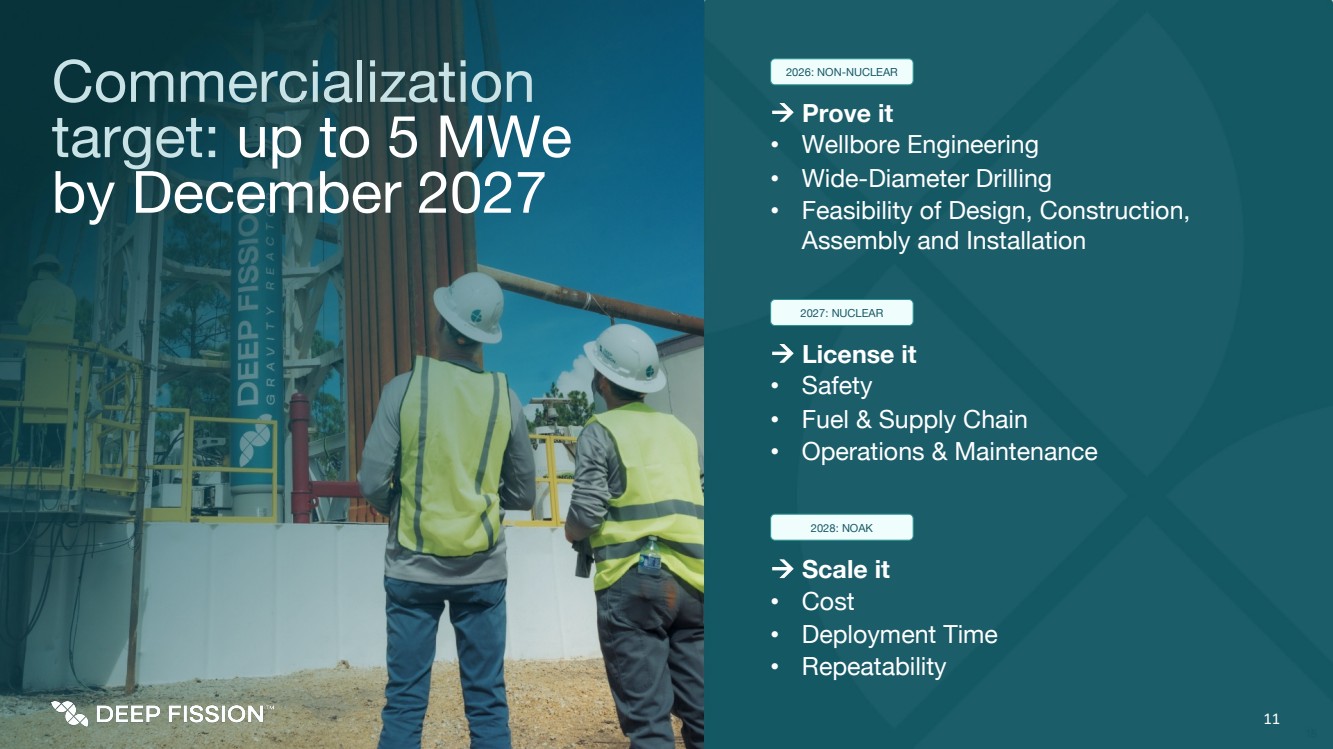
| Commercialization target: up to 5 MWe by December 2027 à Prove it • Wellbore Engineering • Wide-Diameter Drilling • Feasibility of Design, Construction, Assembly and Installation 2026: NON-NUCLEAR à License it • Safety • Fuel & Supply Chain • Operations & Maintenance 2027: NUCLEAR à Scale it • Cost • Deployment Time • Repeatability 2028: NOAK 11 |
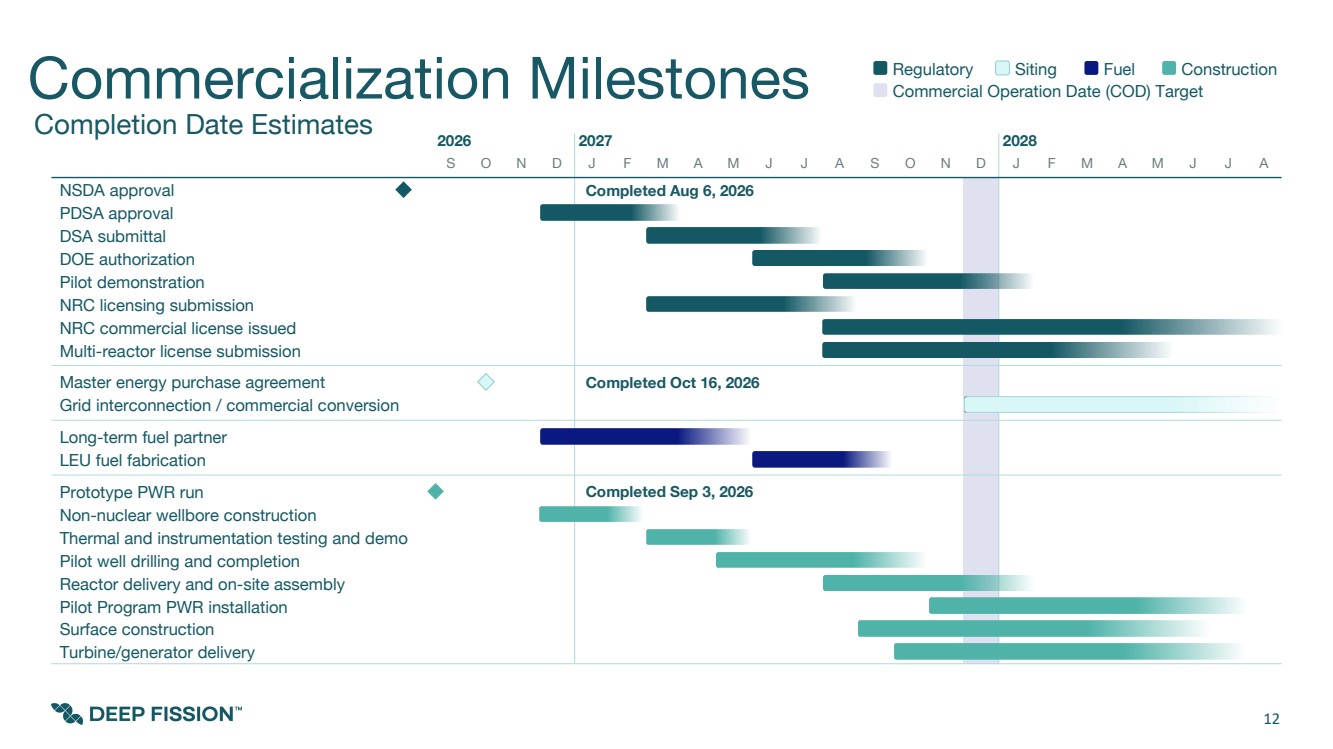
| 2026 2027 2028 S O N D J F M A M J J A S O N D J F M A M J J A NSDA approval Completed Aug 6, 2026 Prototype PWR run Completed Sep 3, 2026 Multi-reactor license submission Non-nuclear wellbore construction DSA submittal NRC licensing submission Thermal and instrumentation testing and demo DOE authorization Pilot well drilling and completion LEU fuel fabrication Reactor delivery and on-site assembly Pilot Program PWR installation Pilot demonstration Surface construction Turbine/generator delivery PDSA approval Long-term fuel partner Grid interconnection / commercial conversion NRC commercial license issued Regulatory Siting Fuel Construction Commercialization Milestones Commercial Operation Date (COD) Target Completion Date Estimates Master energy purchase agreement Completed Oct 16, 2026 12 |
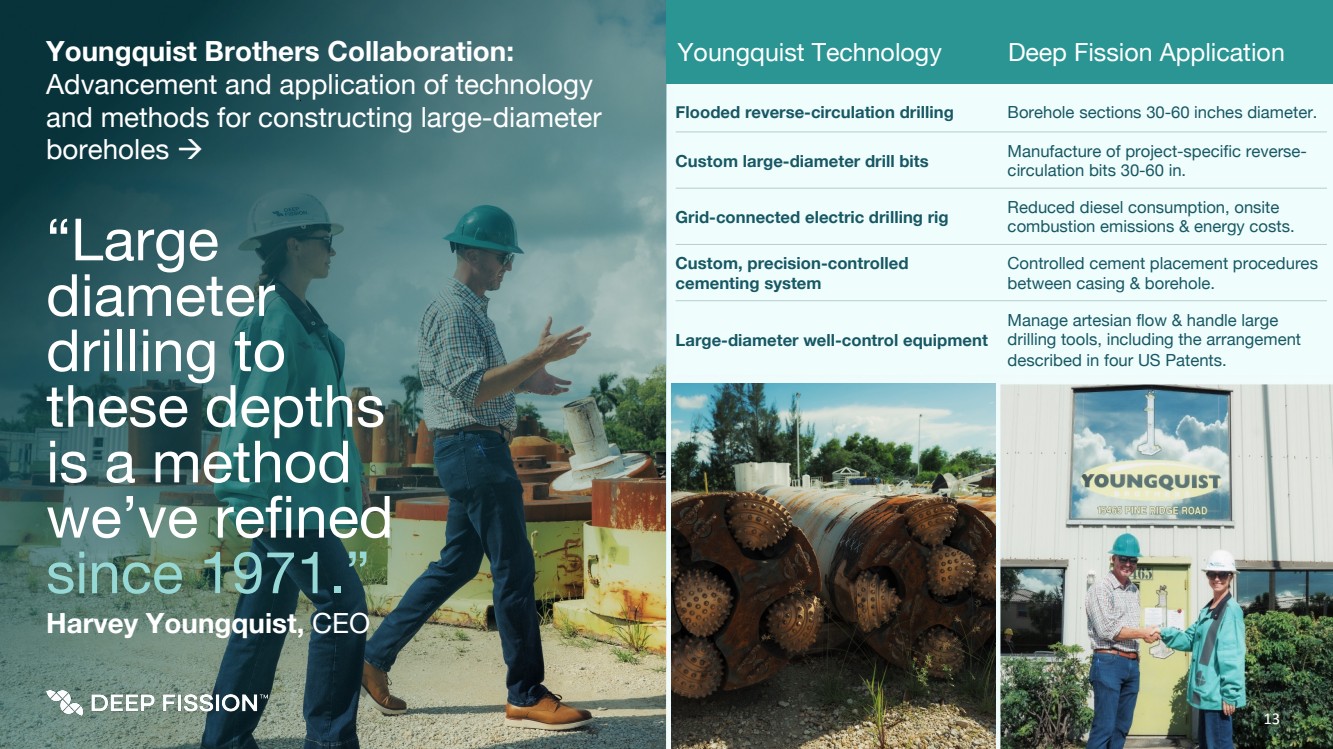
| Liz Muller CEO & Co-Founder “Large diameter drilling to these depths is a method we’ve refined since 1971.” Flooded reverse-circulation drilling Borehole sections 30-60 inches diameter. Custom large-diameter drill bits Manufacture of project-specific reverse-circulation bits 30-60 in. Grid-connected electric drilling rig Reduced diesel consumption, onsite combustion emissions & energy costs. Custom, precision-controlled cementing system Controlled cement placement procedures between casing & borehole. Large-diameter well-control equipment Manage artesian flow & handle large drilling tools, including the arrangement described in four US Patents. Youngquist Technology Deep Fission Application Harvey Youngquist, CEO Youngquist Brothers Collaboration: Advancement and application of technology and methods for constructing large-diameter boreholes à 13 |
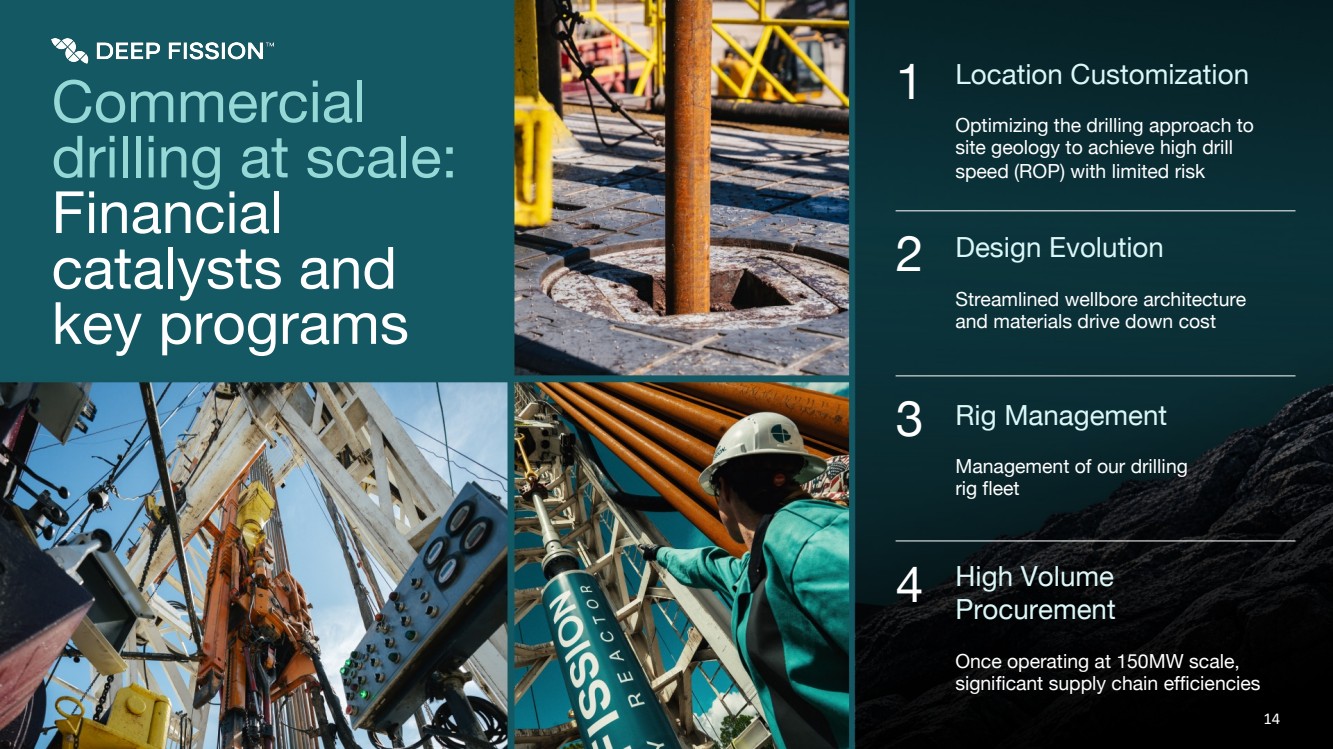
| Commercial drilling at scale: Financial catalysts and key programs 1234 14 Location Customization Optimizing the drilling approach to site geology to achieve high drill speed (ROP) with limited ris k Design Evolution Streamlined wellbore architecture and materials drive down cost Rig Management Management of our drilling rig fleet High Volume Procurement Once operating at 150MW scale, significant supply chain efficiencies |
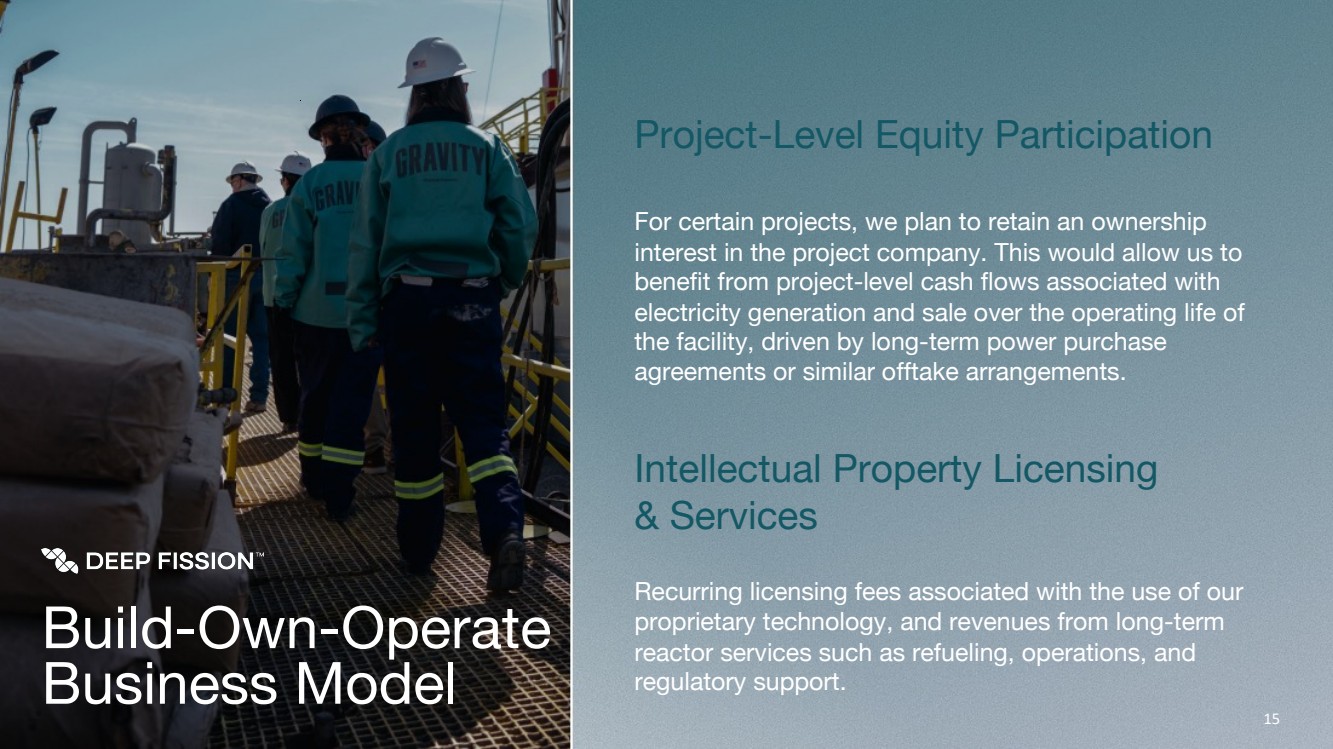
| Build-Own-Operate Business Model Project-Level Equity Participation For certain projects, we plan to retain an ownership interest in the project company. This would allow us to benefit from project-level cash flows associated with electricity generation and sale over the operating life of the facility, driven by long-term power purchase agreements or similar offtake arrangements. Intellectual Property Licensing & Services Recurring licensing fees associated with the use of our proprietary technology, and revenues from long-term reactor services such as refueling, operations, and regulatory support. 15 |
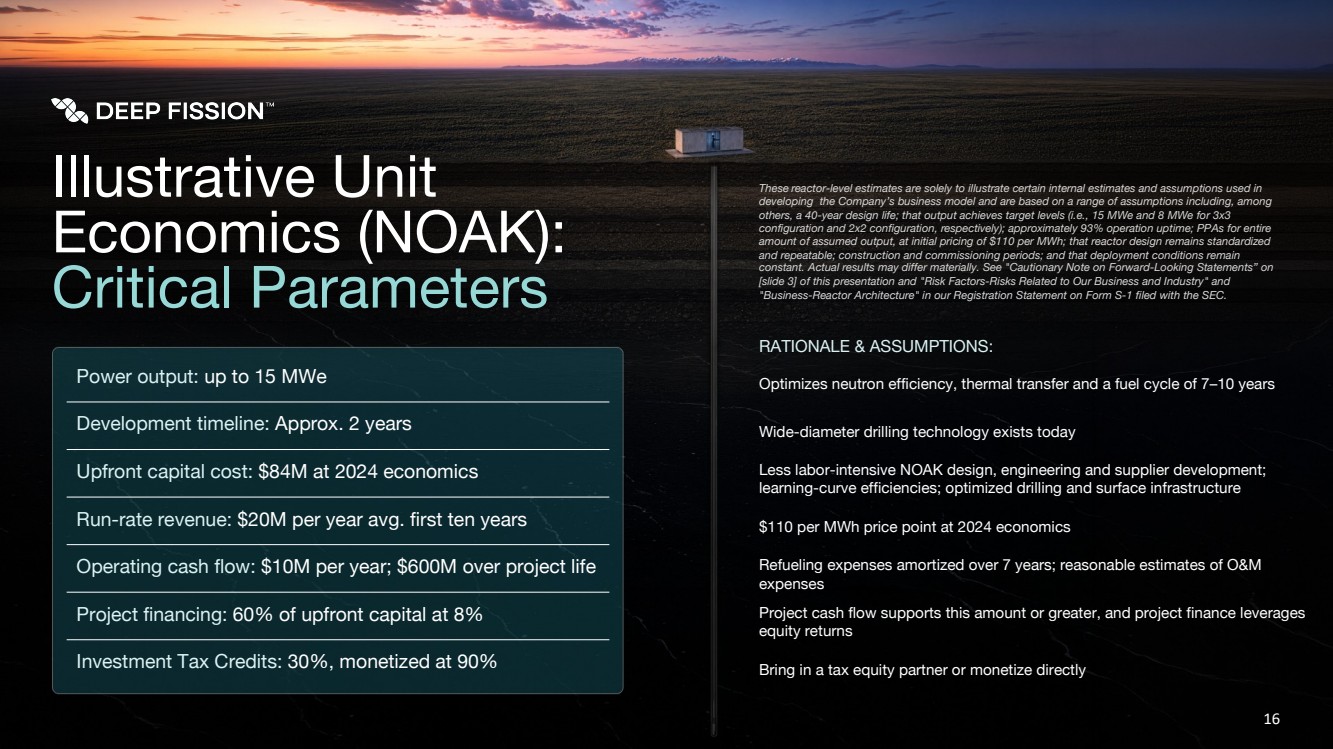
| Illustrative Unit Economics (NOAK): Critical Parameters Power output: up to 15 MWe Development timeline: Approx. 2 years Upfront capital cost: $84M at 2024 economics Run-rate revenue: $20M per year avg. first ten years Operating cash flow: $10M per year; $600M over project life Project financing: 60% of upfront capital at 8% Investment Tax Credits: 30%, monetized at 90% Optimizes neutron efficiency, thermal transfer and a fuel cycle of 7–10 years Wide-diameter drilling technology exists today Less labor-intensive NOAK design, engineering and supplier development; learning-curve efficiencies; optimized drilling and surface infrastructure $110 per MWh price point at 2024 economics Refueling expenses amortized over 7 years; reasonable estimates of O&M expenses Project cash flow supports this amount or greater, and project finance leverages equity returns Bring in a tax equity partner or monetize directly RATIONALE & ASSUMPTIONS: 16 These reactor-level estimates are solely to illustrate certain internal estimates and assumptions used in developing the Company’s business model and are based on a range of assumptions including, among others, a 40-year design life; that output achieves target levels (i.e., 15 MWe and 8 MWe for 3x3 configuration and 2x2 configuration, respectively); approximately 93% operation uptime; PPAs for entire amount of assumed output, at initial pricing of $110 per MWh; that reactor design remains standardized and repeatable; construction and commissioning periods; and that deployment conditions remain constant. Actual results may differ materially. See "Cautionary Note on Forward-Looking Statements” on [slide 3] of this presentation and "Risk Factors-Risks Related to Our Business and Industry" and "Business-Reactor Architecture" in our Registration Statement on Form S-1 filed with the SEC. |
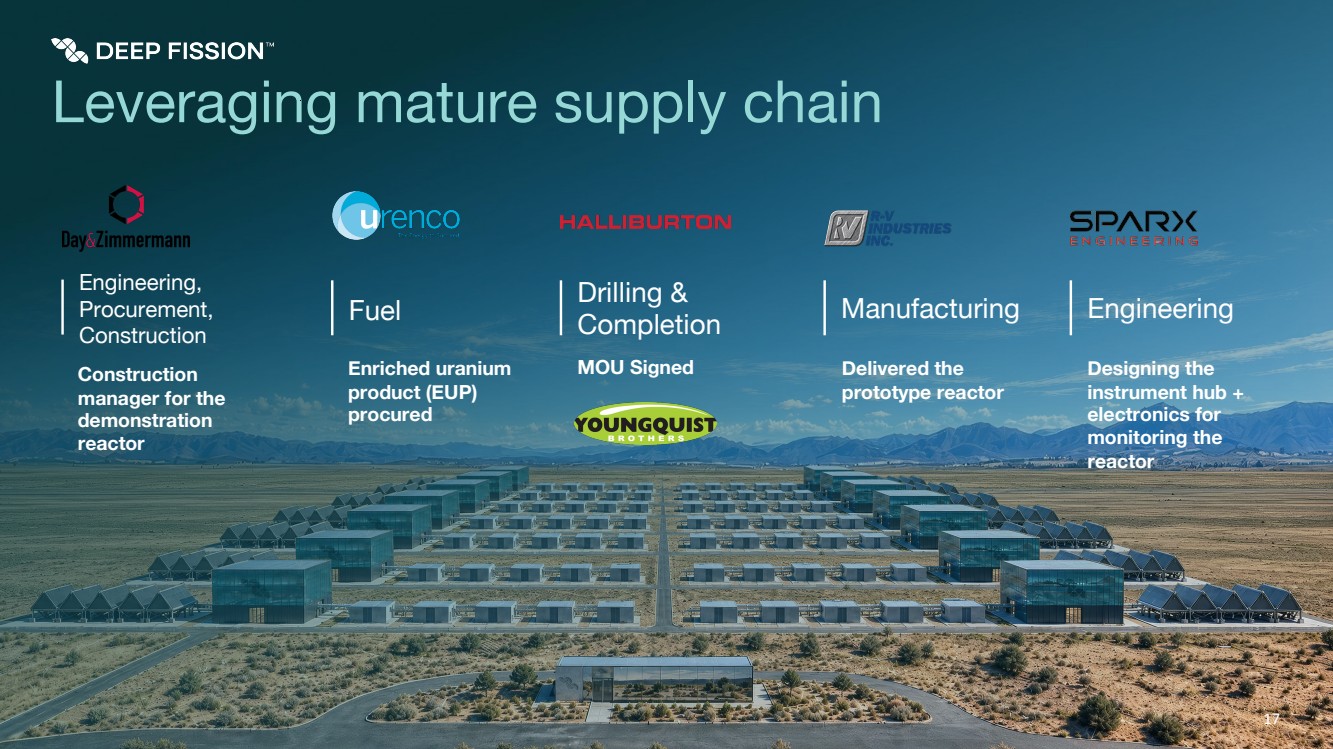
| Fuel Manufacturing Engineering Leveraging mature supply chain Drilling & Completion MOU Signed Designing the instrument hub + electronics for monitoring the reactor Enriched uranium product (EUP) procured Engineering, Procurement, Construction Construction manager for the demonstration reactor Delivered the prototype reactor 17 |
| 18 |
| Energy Resilience for All DeepFission.com |